
Dawn — Senior Seller Finance Note Advisor & Analyst
Moxxie Asset Group · Ft. Lauderdale, FL
Selling your house with owner financing means you act as the bank. Instead of waiting for a buyer to get a bank loan, you let the buyer pay you directly over time, with interest. You collect the sale price plus interest, you open your home to many more buyers, and you create an asset (a seller financed mortgage note) that you can sell later for cash if you ever need it.
Most homeowners have never heard of this strategy, and many assume they can’t use it, especially if they still have a mortgage. Here’s how it works, why it can earn you far more than a traditional sale, and how to set it up the right way.
What Is Owner Financing?
In a traditional sale, your buyer goes to a bank, the bank pays off your mortgage, and you keep what’s left. With owner financing, also called seller financing, there’s no bank in the middle. The buyer makes a down payment, signs a promissory note, and sends you a monthly payment.
Think of it like collecting a rental check, without being a landlord. The buyer owns the home, so property taxes, insurance, and maintenance are their responsibility, not yours. You simply collect the payments.
Why Sell Your House with Owner Financing?
You collect the sale price plus interest
When you sell for cash, you get the sale price and that’s it. When you owner finance, you earn interest on the amount you finance, just like a bank does.
The difference can be large. If you hold a $360,000 note at 9% for 30 years, your borrower would pay you about $1,042,790 in total. That’s roughly $682,790 in interest on top of the $360,000 principal, assuming the borrower makes every payment through the full term. Many loans are paid off or refinanced early, but even a few years of interest can add up to far more than a straight sale.
You open your home to many more buyers
Many good buyers can’t get a bank loan. That doesn’t mean they’re bad borrowers. It means they don’t fit the narrow box banks use. Common examples include:
- Self-employed business owners who show modest income on their tax returns
- People who work in cash-based businesses
- Buyers new to the country who haven’t built a U.S. credit history yet
When you offer owner financing, these buyers can finally purchase a home. Because they’re often thrilled to have that chance, they tend to offer a stronger sale price and a good interest rate. If your house has been sitting on the market, owner financing can be the change that brings in the right buyer.
Steady, collateral-backed income
Your note is backed by the property itself. Compare that with money in the stock market: if the market crashes, there’s nothing to fall back on. With a note, if the borrower stops paying, you can take back the property and sell it again. Doing so takes time and some cost, so a strong borrower and a well-built note are always your first line of protection.
Many sellers also find owner financing can spread out their tax burden. Every situation is different, so talk with your accountant before you decide. Moxxie Asset Group does not give tax or financial advice.
A Real-Life Example: Downsizing
Picture a couple selling a $500,000 home and buying a $300,000 home. They already have the $300,000 they need for the new place. Instead of taking a lump sum for their old home, they offer owner financing.
Now their equity is working for them, earning steady monthly interest backed by real property, with none of the headaches of being landlords. For many people who are downsizing or retiring, this monthly income is exactly what they’re looking for.
The Exit Strategy Most Sellers Don’t Know About: Selling the Note
Here’s what surprises most homeowners: you don’t have to wait 30 years to get your money. Your promissory note is an asset, and it can be sold.
You have two choices:
- Sell the whole note for a lump sum of cash.
- Sell part of the note, called a partial sale. You sell a set number of upcoming payments, and once those are paid, the payments come back to you.
For example, say the couple above needs $75,000 for an upcoming expense or investment. They could sell just part of their note to get that $75,000 and keep the rest of their income. A note is a much more flexible asset than most people realize.
Can I Owner Finance If I Still Have a Mortgage?
Often, yes. Many sellers believe they can’t owner finance until their mortgage is paid off, but there’s a way to do it called a wrap mortgage, or wraparound mortgage.
How a wrap works
In a wrap, you sell your home with your existing mortgage still in place. The buyer’s new note “wraps around” your original loan. The buyer pays you, you pay your mortgage, and you keep the difference.
Here’s an example, assuming 30-year terms on both loans:
- Your home sells for $400,000, and you still owe $100,000 at 5%.
- The buyer puts down $40,000 and signs a $360,000 note at 9%.
- The buyer pays you about $2,896 a month.
- You pay your original mortgage of about $537 a month.
- You keep about $2,360 a month, and the buyer handles taxes, insurance, and maintenance.
What about the due-on-sale clause?
Most mortgages include a due-on-sale clause, which lets the lender demand the full balance when ownership of the property changes. It’s important to know about. In practice, lenders rarely enforce it as long as the mortgage payments keep arriving on time each month.
In a wrap, you’re the one making those payments, so you’re in control. You also have every reason to pay on time: if your mortgage went unpaid, the lender could foreclose, and you’d lose the property backing your note.
If a lender ever did call the loan due, you still have an exit. You can sell your note and use the proceeds to pay off the original mortgage. A note usually sells for less than its full balance, but a well-built note like the one above would typically sell for far more than the $100,000 needed to clear the underlying loan.
Because wraps have extra moving parts, it’s wise to work with an RMLO and a real estate attorney to set one up correctly.
How to Create a Note That Sells for Top Dollar
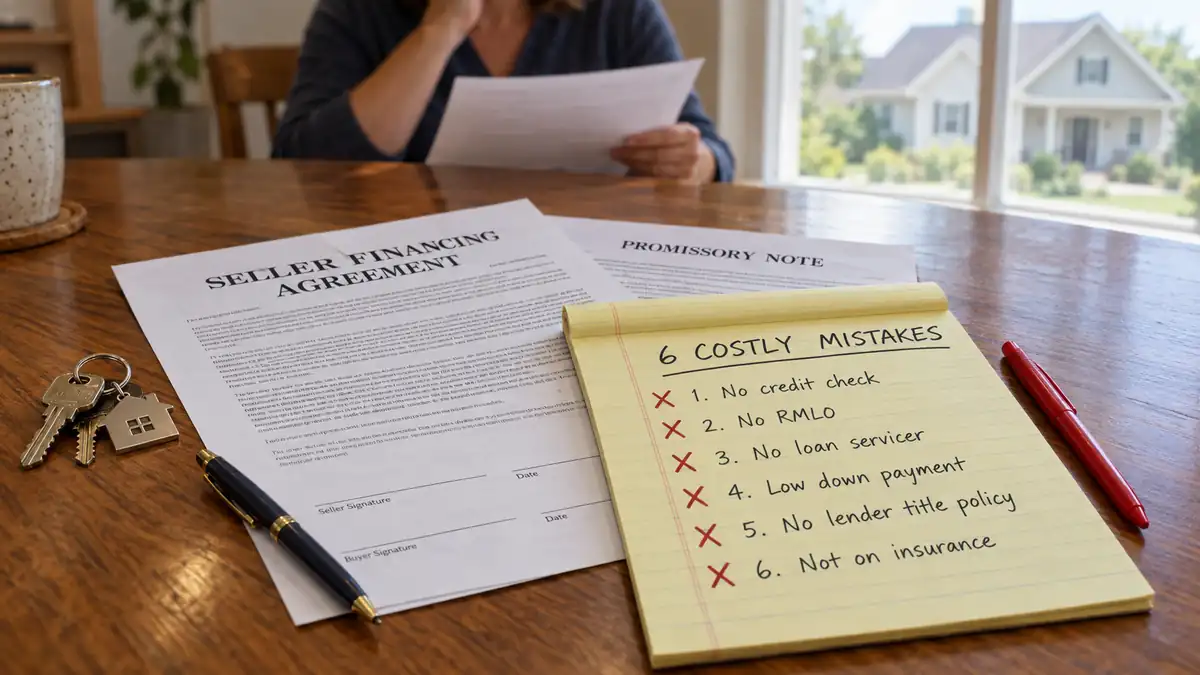
Most people seller finance only once or twice in their lives, so they don’t realize they’re creating an asset someone may buy one day. A note built the right way from the start is worth much more when you sell it. Here’s what matters most:
- A healthy down payment: at least 10%, and more is better. A larger down payment means your buyer has more to lose and you have more protection.
- Decent credit: not perfect, but solid.
- An interest rate above current bank rates: you’re not competing with banks for this buyer, so there’s no reason to match their rates.
- An RMLO (Residential Mortgage Loan Originator): an RMLO checks that your buyer can afford the payments and keeps your paperwork in compliance with lending rules.
- A third-party loan servicer: a servicer collects and records every payment, which makes your payment history easy to prove when you sell.
The two most costly mistakes
- Not pulling the buyer’s credit. Some sellers skip it because they don’t know how, or because they know and trust the buyer. Trust isn’t a credit history, and note buyers will check it.
- Little or no down payment. A buyer with nothing invested is much more likely to walk away, and that lowers your note’s value.
Is Owner Financing Right for You?
Owner financing is a great fit for many sellers, but not all. It may not be right for you if:
- You need all of the money from your sale right away, for example to buy your next home.
- You have very little equity. If you ever sell your note, your original mortgage must be paid off first. With little equity, the note sale may not bring in enough to cover it.
Know What Your Note Is Worth Before You Close
Here’s the best part, and very few sellers know it’s possible: you can find out what your note would sell for before you even sell your home.
Once you’ve decided to sell with owner financing, contact Moxxie Asset Group. We’ll walk you through the whole process:
- What kind of buyer to look for
- How to work with an RMLO to confirm your buyer’s credit, down payment, and income
- How to set the right interest rate
- How to make sure your paperwork is complete and compliant
Once the RMLO has your buyer’s credit, down payment, and interest rate, we can tell you what your note could sell for after the first payment is made. You’ll know your exit number before you close, with no guessing.
This guidance is currently free. If you’re thinking about selling your home with owner financing, reach out to Moxxie Asset Group before you close, and let’s build a note that’s worth the most when you need it.
Moxxie Asset Group:
THE Source for Seller Financed Note Education
Illuminating the Blind Spots of Your Seller Financed Note Journey