

Most note holders simply call it a mortgage note — and that is perfectly fine. Whether you refer to it as a mortgage note, a deed of trust note, or a seller-financed note, Moxxie Asset Group reviews and purchases them all.
Request a FREE Note ReviewSell Your Mortgage Note in North Carolina — Trusted Note Buyer Statewide
North Carolina ranks 4th in the nation for seller-financed notes — with over 4,400 created every year. From Charlotte suburbs and Raleigh-Durham to mountain land in the western highlands and coastal properties near Wilmington, we give you a free, honest review of what your note is worth. No pressure. No obligation. Call 954-466-7111 or request a free review below. Whether you hold a seller financed deed of trust, an owner financed installment note, or a private mortgage note, Moxxie Asset Group makes it simple to sell your mortgage note in North Carolina — no fees, no pressure.
Free — No Obligation
Not ready to sell yet? Get free insider note tips.
Note valuation tips, market trends & state-specific strategies — straight to your inbox.
✉ Get Free Note Tips
North Carolina
North Carolina's Growth Is Creating Thousands of Seller-Financed Notes Every Year
Dawn — Senior Seller Finance Note Advisor & Analyst
Moxxie Asset Group · Ft. Lauderdale, FL
North Carolina's fast-growing population, booming tech and finance sector, and active real estate market make it one of the most dynamic seller-financing states in the Southeast. From Charlotte's suburban sprawl to the Research Triangle's investor activity and western NC's mountain land market, seller-financed notes are created throughout the state. If you're ready to sell your mortgage note in North Carolina, Moxxie Asset Group is the trusted North Carolina mortgage note buyer serving all 100 counties — with no fees, no obligation, and a response within one business day. If you’ve been searching “sell my mortgage note” for a North Carolina property, you’re in the right place — we buy mortgage notes secured by real estate across North Carolina, and we can help you sell mortgage note payments in full or in part.
Want a deeper look at North Carolina mortgage note law, foreclosure timelines, and what affects your note's value? Read our complete guide: How to Sell Your Owner Financed Mortgage Note in North Carolina — A Complete Guide →
Charlotte Metro Notes
Charlotte's explosive suburban growth in Mecklenburg, Union, Cabarrus, and surrounding counties generates a large volume of seller-financed residential and investment property notes.
Mountain & Rural Land Notes
Western NC mountain properties, Piedmont farmland, and rural land across the state produce a steady stream of seller-financed notes — many involving land-only transactions where owner financing is the norm.
Research Triangle & Coastal
Raleigh-Durham's tech-driven real estate market and NC's Outer Banks and Wilmington coastal communities produce seller-financed notes across a wide range of property types and values.
Sell Your Mortgage Note Anywhere in North Carolina — We Buy Statewide
North Carolina ranks 4th nationally for seller-financed notes. From Charlotte suburbs to the Research Triangle to the Blue Ridge Mountains to the Outer Banks coast — Moxxie Asset Group buys North Carolina mortgage notes statewide. Whether you want to sell your mortgage note in North Carolina from Charlotte, Raleigh, Greensboro, or any other county, we make the process simple. As a dedicated North Carolina mortgage note buyer, we review every note personally and respond within one business day.
Sell Your Mortgage Note in Charlotte & Mecklenburg County
Charlotte is North Carolina's largest city and most active real estate market. We buy seller-financed mortgage notes on Charlotte-area properties including Mecklenburg, Union, Cabarrus, Gaston, and Iredell counties. The Charlotte metro's strong population growth has created significant seller-financing activity on both residential and investment properties.
Sell Your Mortgage Note in Raleigh, Durham & the Research Triangle
The Research Triangle — Raleigh, Durham, and Chapel Hill — is one of the fastest-growing markets in the Southeast. We purchase mortgage notes in Wake, Durham, Orange, and Chatham counties. The Triangle's tech and university economy drives strong demand for seller-financed investment properties.
Sell Your Mortgage Note in Greensboro, Winston-Salem & the Triad
The Piedmont Triad generates consistent seller-financing activity, particularly on investment and rental properties. We buy notes in Guilford, Forsyth, Alamance, and Randolph counties. Greensboro and Winston-Salem's affordable housing market has made seller financing a popular tool for both buyers and sellers.
Sell Your Mortgage Note in Asheville, the Mountains & Coastal NC
Western NC mountain properties and Outer Banks coastal properties both generate unique seller-financing situations — often on vacation homes, cabins, and land. We buy notes in Buncombe, Henderson, Brunswick, New Hanover, Dare, and all coastal and mountain counties.
Don't see your city? If you want to sell a note anywhere in North Carolina, we buy notes in every county. Call 954-466-7111 or submit your note details below.
Request a FREE Note Review ✉ Get FREE Note TipsAll North Carolina Cities & Regions We Serve
How to Sell Your Mortgage Note in North Carolina
Request Your Free Review
Fill out the form with basic details about your note. Even partial information is fine.
We Review and Connect
Our team reviews your submission and reaches out to discuss your NC note and options — no pressure, no sales pitch.
Review Your Options
If your note qualifies, we prepare a formal offer — full or partial purchase. You decide at every step.
Close and Receive Funds
We handle all North Carolina paperwork and recording. Most closings complete within 3 to 5 weeks.
What Note Buyers Are Actually Evaluating
When our team reviews your note, here is what we are looking at — and how each factor affects your offer: When you sell a mortgage note in North Carolina, these are the factors that determine what a note buyer will pay.
The creditworthiness of the borrower making payments on your note. A stronger credit score signals lower default risk and directly improves your offer. Even a rough credit range — strong, fair, or weak — helps us evaluate the note before a full review.
The larger the original down payment, the more skin in the game the borrower had from day one. A 10%+ down payment is a strong signal of borrower commitment and significantly reduces default risk — making your note more attractive to note buyers.
The remaining loan balance divided by the current property value. Lower LTV means more equity in the property — the single biggest pricing factor.
How many consecutive on-time payments the borrower has made. 12+ months of clean payment history significantly improves your offer.
First position notes are far easier to sell than second position notes. A second lien means another lender has priority claim on the property — that adds risk and typically reduces the offer significantly.
Higher interest rates on your note generally mean a better yield — and therefore a better offer — for the note buyer.
Single-family residential notes in desirable markets command better pricing than rural land or commercial notes. Strong markets like Miami, Atlanta, Houston, and Phoenix are favorable.
Deed of trust states with faster non-judicial foreclosure timelines are generally more favorable for note buyers — and that can translate into a slightly better offer for you.
How long ago the note was created. Very new notes with under 6 months of payment history are harder to price — but once seasoning builds, age alone is rarely a deciding factor.
Whether the property is owner-occupied, tenant-occupied, or vacant. Owner-occupied is the preferred scenario, but tenant-occupied notes are still purchasable. Vacant properties carry the most risk.
The price the property sold for when the note was created. Helps verify the transaction was arm's length and the original LTV was reasonable — useful context but rarely changes the offer on its own.
Very small note balances — typically under $30,000–$40,000 — can be harder to sell because transaction costs consume more of the yield. Not a dealbreaker, but it may affect pricing on smaller notes.
Whether the note is fully amortizing, interest-only, or has a balloon payment. Standard amortizing notes are the easiest to price. Balloon and interest-only structures are purchasable but require additional analysis.
Want to know exactly what documents we need? See our full Note Documents Checklist for a step-by-step breakdown of everything to gather before your review. New to the process? Read our guide on how to sell a mortgage note.
Free — No Obligation
Ready to Sell Your Mortgage Note in North Carolina?
Our team reviews your note details and responds within one business day — no fees, no pressure, no obligation.
Looking to sell mortgage note payments for a lump sum? Moxxie Asset Group purchases seller financed, owner financed, and private mortgage notes backed by North Carolina real estate. Whether your note is a deed of trust, mortgage, or land contract — we are your trusted North Carolina mortgage note buyer.
We Buy All Types of Seller-Financed NotesWe Buy Mortgages, Trust Deeds & Land Contracts in North Carolina — Sell Your Mortgage Note for a Your Payments for a Lump Sum
Seller-financed notes go by many names — seller-financed mortgage note, owner-financed mortgage note, or private mortgage note. Whatever you call yours, selling a note starts with a free review — and Moxxie Asset Group buys them. We purchase deed of trusts, deeds of trust, and installment land contracts across North Carolina. Note holders looking to sell their mortgage note in North Carolina will find our process straightforward: free review, written offer, and closing in 3–5 weeks when all documents are received and title is clear. The state's anti-deficiency statute (N.C.G.S. §45-21.38) protects buyers after foreclosure — a unique legal feature that note holders and buyers both need to understand.
📍 We serve all of North Carolina: Charlotte, Raleigh, Greensboro, Durham, Winston-Salem, Fayetteville, Asheville, Wilmington, and all NC counties.
Can I sell my owner-financed mortgage note in North Carolina?
Yes. Owner-financed notes in North Carolina — secured by a deed of trust — are fully transferable. The note is endorsed and the deed of trust is assigned and recorded. NC's non-judicial foreclosure process (typically ~110 days) and the anti-deficiency protection under N.C.G.S. §45-21.38 are important factors in note valuation. Call Moxxie Asset Group at 954-466-7111 for a free review.
Can I sell my private mortgage note in North Carolina?
Yes. Private mortgage notes in North Carolina — also called owner-financed or seller-financed notes — are regularly bought and sold. Moxxie Asset Group purchases NC private mortgage notes statewide, from Charlotte and Raleigh to rural mountain and coastal counties. Call 954-466-7111 for a free, no-obligation quote.
Does Moxxie Asset Group buy mortgages, deeds of trust, and land contracts in North Carolina?
Yes. We buy seller-financed notes secured by North Carolina deeds of trust, mortgages, and installment land contracts. NC primarily uses deeds of trust for seller-financed transactions. Installment land contracts must be recorded under N.C. Gen. Stat. §47-20. Call 954-466-7111 to discuss your specific instrument and get a free quote.
North Carolina Seller Financing Law — Detailed Reference
North Carolina Deed of Trust, Foreclosure & Recording Law for Seller-Financed Notes
North Carolina has some of the most specific and seller-protective laws governing private mortgage notes in the Southeast. If you created a seller-financed note in NC — or are considering selling one — understanding these statutes is essential. The information below is drawn directly from the North Carolina General Statutes.
1. North Carolina Uses Deeds of Trust — Not Mortgages
North Carolina is a deed of trust state. In seller-financed transactions, the security instrument is a Deed of Trust — not a mortgage. A Deed of Trust involves three parties:
- Grantor (Borrower/Buyer) — the buyer who owes the debt and conveys the property into trust as security
- Trustee — a neutral third party (often an attorney) who holds legal title and has the power to sell the property upon default
- Beneficiary (Lender/Seller) — the seller who holds the promissory note and receives payments; this is you
The Deed of Trust must be recorded with the Register of Deeds in the county where the property is located to be enforceable against third parties and to establish lien priority (N.C. Gen. Stat. § 47-20). An unrecorded Deed of Trust is valid between the parties but provides no priority protection against subsequent purchasers or lienholders who record first.
What this means for note sellers:
When you sell your note, the buyer (note investor) will require a recorded Assignment of Deed of Trust with the county Register of Deeds to establish their lien position. If your original Deed of Trust was never properly recorded, or was recorded in the wrong county, this creates a cloud on title that can significantly reduce your note's value or make it unsaleable.
2. Recording Requirements for Seller-Financed Notes in NC
Under N.C. Gen. Stat. § 47-20, deeds of trust and mortgages must be registered in the county where the land lies to be valid against subsequent purchasers and creditors. Key recording requirements:
Acknowledgment Requirement
The Register of Deeds will not accept any instrument for recording unless the grantor's execution has been proved or acknowledged before an officer with authority to take acknowledgments — typically a notary public — and the acknowledgment includes the officer's signature, commission expiration date, and official seal (N.C. Gen. Stat. § 47-14).
County-Level Recording
Each county in NC has its own Register of Deeds. A Deed of Trust must be recorded in the county where the property is physically located. If a property spans two counties, it should be recorded in both. NC has 100 counties, each with its own recording system and fees.
Priority Rule (First to Record Wins)
NC follows a "race-notice" recording statute. The first party to record a properly executed instrument — and who takes without notice of a prior unrecorded claim — wins priority. If you have a second lien on the property, note buyers will discount heavily, as foreclosure of a senior lien can wipe out a junior position.
Land Contract Recording
NC also allows installment land contracts (contract for deed). Under N.C. Gen. Stat. § 47-20, these instruments must also be recorded to protect the buyer's interest. An unrecorded land contract may be voided by a subsequent purchaser or creditor who records first — a significant risk for both parties.
NC Recording Fees (typical):
Register of Deeds recording fees vary by county but are typically $26 for the first 15 pages, plus $4 per additional page, plus an excise tax stamp fee where applicable. Assignment of Deed of Trust fees are similar. Contact your county Register of Deeds for current rates.
3. NC Foreclosure Law — Power of Sale Process (N.C.G.S. Chapter 45, Article 2A)
North Carolina uses a non-judicial power of sale foreclosure — but it is not purely non-judicial. NC requires a Clerk of Superior Court hearing before any sale can proceed, making it a hybrid system that is unique among non-judicial foreclosure states. The full timeline typically runs 60 to 120 days from filing to sale completion.
Default & Pre-Foreclosure Notice
For loans classified as "home loans" under N.C. Gen. Stat. § 45-101, the note holder must send a written pre-foreclosure notice at least 45 days before filing. The notice must include: the nature of the default, the amount needed to cure, the lender's name and address, and information about housing counselors. This requirement was added by the NC Homeowner & Homebuyer Protection Act. For non-home loans (commercial, land, investment), this pre-notice period does not apply.
File Notice of Hearing with Clerk of Superior Court
The trustee or mortgagee files a Notice of Hearing with the Clerk of Superior Court in the county where the property is located (N.C. Gen. Stat. § 45-21.16). The filing must identify: the debt, the default, the note holder, and the property. Once filed, all parties entitled to notice must be served at least 10 days before the hearing date. If a party cannot be personally served, the sheriff may post notice on the property at least 20 days before the hearing.
Clerk's Hearing — Judicial Oversight
This is what makes NC unique. Before any sale can proceed, the Clerk of Superior Court must hold a hearing and make four specific findings: (i) that a valid debt exists and the foreclosing party is the holder; (ii) that a default has occurred; (iii) that the note holder has the right to foreclose under the instrument; and (iv) that required notices were given. Either party may appeal the Clerk's decision to a district or superior court judge within 10 days, and the appeal is heard de novo (fresh review). Posting a bond stays the foreclosure during appeal.
Notice of Sale — 20-Day Publication Requirement
After the Clerk authorizes the sale, the trustee must publish notice of the sale in a qualifying newspaper once per week for two successive weeks, with the last publication no more than 10 days before the sale. Notice must also be posted at the county courthouse at least 20 days before sale and mailed to all parties entitled to notice (N.C. Gen. Stat. § 45-21.17).
Trustee's Sale at Courthouse
The sale is held publicly at the courthouse door (or another designated public location within the county). The property is auctioned to the highest bidder. The trustee files a preliminary report within 5 days of the sale. Any party may submit an upset bid — which must exceed the reported sale price or last upset bid by at least 5% (minimum $750 increase) — within 10 days of the report being filed.
10-Day Upset Bid Period & Final Sale
After the trustee's sale, there is a mandatory 10-day upset bid period. If no upset bid is filed, the sale becomes final. If an upset bid is filed, a new 10-day period begins. Once no further bids are received, the trustee delivers a deed to the purchaser. There is no court confirmation required once the upset bid period expires — a significant distinction from states requiring court confirmation. Total time from filing to final sale: typically 60 to 120 days absent delays, appeals, or bankruptcy.
Borrower's Right to Cure (Reinstatement)
The power of sale is terminated if, before the sale time, the borrower pays or tenders the full amount of the secured obligation plus all expenses incurred for the sale. In plain terms: the borrower can stop the foreclosure at any point before the gavel drops by paying everything owed. This right cannot be contractually waived. For seller-financed note holders, this means a borrower who reinstates at the last moment restores the original loan — which is why experienced note buyers price the full reinstatement exposure into their offer.
Military Service Protection:
No foreclosure under a power of sale may proceed during, or within 90 days after, a borrower's period of military service if the mortgage or deed of trust originated before the service began. The Clerk will not conduct the hearing without a certification that the borrower is not currently protected by this provision.
4. The Anti-Deficiency Statute — N.C.G.S. § 45-21.38 (Critical for Note Sellers)
⚠ The most important NC law for seller-financed note holders to understand:
If your buyer defaults on a purchase money note, N.C. Gen. Stat. § 45-21.38 bars you from obtaining a deficiency judgment against your buyer's personal assets. Your only remedy is to foreclose and take the property back. If the foreclosure sale produces less than the loan balance, you absorb that loss — you cannot sue the buyer for the difference.
What is a "purchase money" note? A note is purchase money when the loan proceeds were used to purchase the property securing the note. When a seller takes back financing at closing — the most common seller-financing scenario — the note is almost always a purchase money note. This means the anti-deficiency bar almost always applies to seller-financed notes created at the point of sale.
Fair Value Defense — § 45-21.36
Even in cases where a deficiency judgment is otherwise available (e.g., non-purchase money notes), N.C. Gen. Stat. § 45-21.36 allows the borrower to raise the property's fair market value as an offset. The deficiency is calculated as the difference between the debt and the fair market value — not necessarily the foreclosure sale price.
Why Note Buyers Scrutinize Equity
Because you cannot chase the borrower's personal assets in NC, the property itself must be worth enough to cover the loan balance if foreclosure occurs. A note with 90%+ LTV in a flat-value market carries significant risk for note buyers — they may decline or heavily discount it. Notes with <80% LTV, strong payment history, and appreciation in the collateral market command the best prices.
Note Drafting Requirement
To receive purchase money protection, the note should clearly disclose on its face that it is a purchase money instrument — i.e., that the proceeds were used to purchase the secured property. A properly drafted purchase money note prevents ambiguity about anti-deficiency application in future legal proceedings.
Bottom line for note sellers in NC:
Your note's value depends heavily on the property's equity cushion — because that equity is your only protection if the buyer stops paying. Note buyers price this risk into their offers. A note with strong equity (low LTV), seasoned payment history, and a property in a growing NC market (Charlotte, Raleigh, Asheville) will sell at a significantly better price than a thin-equity note in a stagnant market.
5. The "Wet-Ink" Original Note Requirement
One of the most common obstacles in selling a seller-financed note is the original promissory note. A photocopy or scanned version is generally not sufficient to transfer or enforce the note in North Carolina. Here is why this matters:
- Negotiability requires the original — Under the Uniform Commercial Code (UCC Article 3, adopted in NC), a promissory note is a negotiable instrument. Transferring rights under it — particularly to become a "holder in due course" — generally requires physical delivery of the original instrument.
- Lost note affidavit process — If the original note is lost or destroyed, the note holder must execute a Lost Note Affidavit and often must post a bond or indemnity as protection for the note buyer. This is a time-consuming process, typically requiring an attorney, and most note buyers will discount significantly or decline to purchase a note with a lost original.
- Where to look — Check with the closing attorney who handled the original transaction, as they often retain a copy of the closing package. Original notes are sometimes accidentally stored with property deed copies rather than with financial records.
Action item before you contact any note buyer:
Locate your original "wet-ink" promissory note before reaching out for quotes. Having it in hand will accelerate your timeline and signal to buyers that your note is ready to close. If you cannot locate it, contact the closing attorney from the original transaction first.
6. How a Note Transfer Works in North Carolina
When you sell your seller-financed note, the following documents are required to complete the legal transfer in North Carolina:
Allonge / Endorsement of Note
The original promissory note is endorsed (signed over) to the new holder. If there is no room on the note itself for an endorsement, an allonge — a separate piece of paper firmly attached to the note — is used. This transfers legal rights under the note to the buyer.
Assignment of Deed of Trust
The Deed of Trust (the security interest in the property) is assigned to the new note holder and recorded with the Register of Deeds in the county where the property is located. This publicly establishes the new holder's lien position and is required by NC law for the transfer to be effective against third parties.
Substitution of Trustee (Optional)
If the new note holder wants to appoint its own trustee (the neutral third party who holds the power of sale), a Substitution of Trustee document is executed and recorded. This is common when institutional buyers want their preferred trustee in place for any future foreclosure.
Borrower Notification
Under RESPA (for qualifying loans), the borrower must be notified of the transfer. The note buyer typically sends a "Hello Letter" to the borrower informing them who now holds the note and where to send payments. This is handled by the note buyer, not the seller.
Moxxie Asset Group handles all NC transfer paperwork:
We coordinate the allonge, assignment of deed of trust, recording with the Register of Deeds, and borrower notification. You do not need to hire a separate attorney to manage the closing process — we handle it. Most NC note closings complete within 3 to 5 weeks from offer acceptance.
7. How to Structure a Seller-Financed Note in NC for Maximum Saleability
If you are creating a new seller-financed note — or advising a buyer/seller on one — these NC-specific structuring principles maximize the note's future market value:
- Keep LTV at or below 80% — Require at least 20% down payment from the buyer. This creates an equity cushion that protects both you and the eventual note buyer, particularly important given NC's anti-deficiency statute.
- Use a Deed of Trust, not a mortgage — NC's power of sale foreclosure process is faster and less expensive than a judicial mortgage foreclosure. Always use a Deed of Trust for NC seller financing.
- Record the Deed of Trust immediately — Record at the county Register of Deeds on the day of closing or the next business day. Do not delay — an unrecorded instrument has no priority protection.
- Use a licensed NC attorney for closing — North Carolina requires that real estate closings be supervised by a licensed NC attorney. An attorney can also properly draft the Deed of Trust, ensure the purchase money nature is disclosed on the note face, and handle proper recording.
- Verify borrower credit and income — Document the borrower's creditworthiness at origination. Note buyers will conduct their own due diligence, but having organized records (credit report, income verification, employment history) speeds the process and improves your offer.
- Set a market-rate or above-market interest rate — Notes with interest rates at or above current market rates sell at smaller discounts. A note bearing a 3% rate in a 7% market will be discounted steeply; a 9% rate in the same market may sell near par.
- Keep detailed payment records from day one — A 12+ month payment history of on-time payments ("seasoning") substantially increases your note's market value. Use a third-party loan servicer if possible, as their records are considered more reliable by note buyers than self-kept ledgers.
This information is provided for educational purposes only and does not constitute legal or tax advice. Laws and fees are subject to change. Consult a qualified North Carolina real estate attorney for guidance specific to your situation. Sources: N.C. Gen. Stat. Chapter 45, Article 2A (Power of Sale Foreclosure); N.C. Gen. Stat. § 47-14 (Recording); N.C. Gen. Stat. § 47-20 (Deed of Trust Recording Priority); N.C. Gen. Stat. § 45-21.38 (Anti-Deficiency).
North Carolina Note Law & Transfer Process
What You Need to Know About Selling a Note in North Carolina
If your buyer stops paying — you are protected
North Carolina law handles the process without going to court in most cases. It takes about 120 days and you never have to hire a lawyer or go in front of a judge for the standard process. (Deed Of Trust — non-judicial process)
What happens if the property is ever taken back
North Carolina law limits the ability to collect any deficiency after a foreclosure sale to the fair-market value of the property — so your buyer cannot be sued for more than the property is actually worth. (N.C.G.S. § 45-21.36)
Documents we handle for you
When you sell your mortgage note, we take care of all the paperwork — including recording the transfer with the county. You do not need to figure out what documents are needed or how to file them. We walk you through everything step by step.
Does it cost anything to transfer my note?
North Carolina's excise tax applies to property deeds — not to note assignments. A small recording fee applies when the transfer is recorded with the county. We explain all costs before you commit to anything.
This information is provided for educational purposes only and does not constitute legal advice. Consult a qualified attorney for guidance specific to your situation. Source: North Carolina General Statutes, Chapter 45.
North Carolina Note Holder FAQ
Can I sell my seller-financed mortgage note in North Carolina?
It starts with a free review — you share basic details about your note and we get back to you within one business day. If your note qualifies and you want to move forward, we prepare a written offer. You review it and decide — no pressure either way. If you say yes, we handle all the paperwork and you receive your lump sum at closing, typically within 3 to 5 weeks when all documents are received and title is clear.
How does selling a mortgage note work in North Carolina?
The process starts with a free note review of your note's balance, terms, property type, and payment history. North Carolina notes are secured by a Deed of Trust, so transferring your note requires a recorded Assignment of Deed of Trust with the county Register of Deeds plus an allonge or endorsement of the promissory note. If your note is a purchase-money note, N.C. Gen. Stat. § 45-21.38 means your only recovery on default is foreclosure on the property itself — you generally cannot pursue the borrower's other assets — so buyers evaluate the borrower's credit, payment history, and loan-to-value carefully. North Carolina's non-judicial foreclosure runs through a Clerk of Superior Court hearing and typically takes 60 to 120 days (N.C. Gen. Stat. §§ 45-21.1 to 45-21.38).
What documents do I need to sell my North Carolina mortgage note?
To sell your seller-financed mortgage note in North Carolina, you will need: the original promissory note (the wet-ink original is required — not a copy), the recorded Deed of Trust from the county Register of Deeds, the settlement statement or HUD-1 from the original property closing, payment history records showing all payments received, and your title insurance policy. North Carolina buyers will also review the borrower's credit history and current property value to assess loan-to-value. Having these documents organized before requesting a quote will speed up the review process.
What types of NC notes does Moxxie buy?
We review notes secured by single-family homes, land and rural parcels, mountain properties, multi-family, and commercial real estate throughout North Carolina. Charlotte metro, Research Triangle, Asheville, and coastal/rural notes are all within our active market.
Do I have to sell the entire note?
No. A partial sale lets you access a lump sum of cash now while retaining the remaining payment stream — for example, you might sell the next 36 months of payments to get cash now and keep the remainder of the note for later. A split buyout, receiving your money in two or more scheduled lump sums, is also available. It is a flexible option for North Carolina note holders who need liquidity without giving up all future income.
How much is my North Carolina note worth?
Three factors matter most: the LTV ratio (loan-to-value), which compares what's still owed to the home's current value — investors prefer 80% or less, so a $150,000 balance on a $200,000 home, a 75% LTV, is attractive; seasoning, meaning 12+ months of on-time payments, which makes a note more valuable; and the discount an investor applies to protect against risk and earn a return, which means you will rarely receive the full remaining balance in cash (a low interest rate typically means a steeper discount). NC's growing real estate market — particularly in Charlotte and the Research Triangle — can positively influence values for well-structured notes. Request a free review for an honest assessment.
What are the steps to sell my owner-financed note in North Carolina?
The process has four steps: first, gather your documents — the promissory note, recorded Deed of Trust, settlement statement, and payment history. Second, get quotes by submitting your note details for a free, no-obligation review. Third, review offers and compare purchase price and structure (full, partial, or split buyout). Fourth, close the deal — the buyer handles underwriting, the title check, and closing costs, and once documents are signed, funds are wired directly to your bank account.
Does Moxxie buy notes across all of NC?
Yes. We review and purchase notes backed by properties throughout all of North Carolina — Charlotte, Raleigh, Durham, Asheville, Wilmington, western mountain counties, and all rural counties statewide.
I have a seller-financed note in North Carolina — can you buy it?
Yes. If someone is making monthly payments to you on a property you sold using owner financing — you have a seller-financed note and we can review it. In North Carolina these notes are sometimes called deed of trust notes instead of mortgage notes — but the name does not matter. Whatever you call it — if someone owes you payments on a property you sold, we want to hear from you.
Sell Your Mortgage Note in North Carolina — Get a FREE Note Review Today
Deed of trust law, foreclosure timelines, and what makes NC notes valuable — all in one guide.
Read the Guide →Why North Carolina Note Holders Choose Moxxie Asset Group
Selling a mortgage note is a one-time decision for most note holders. You deserve a buyer who is straightforward, experienced with North Carolina notes, and focused on your outcome — not just a quick close at the lowest possible price. Not sure yet whether to sell mortgage note payments? Many North Carolina note holders start by asking, “What would my note be worth if I sell my mortgage note?” We buy mortgage notes nationwide and will give you a clear, honest answer.
We Know North Carolina Notes
Our team understands this market, the deed of trust structure used in this state, and what makes a note trade at full value. We review notes statewide and give you an honest, informed assessment — not a lowball offer.
Honest, No-Pressure Process
Whether you are selling a mortgage note in full or selling mortgage note payments in part, our team reviews your note and responds within one business day. We walk you through exactly how we arrived at our offer — no mystery pricing, no bait-and-switch, no pressure. If a full sale isn't right for you, we'll tell you. A partial note purchase may be a better fit.
Free Review — No Fees, Ever
There are no upfront fees, no application costs, and no obligation attached to your review. We cover our costs at closing — only if you decide to sell. Call 954-466-7111 or request your free review below.
Request a FREE Note Review ✉ Get FREE Note TipsReal Feedback From Real People
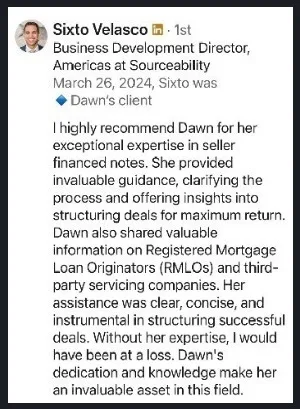
“I highly recommend Dawn for her exceptional expertise in seller financed notes. She provided invaluable guidance, clarifying the process and offering insights into structuring deals for maximum return. Her assistance was clear, concise, and instrumental in structuring successful deals.”

“I was pleasantly surprised that you were willing to give me advice as a newer investor from an objective position trying to help me move forward. Free advice, no expectations, and a kind demeanor. You were knowledgeable, patient, and definitely have an abundance mindset!”
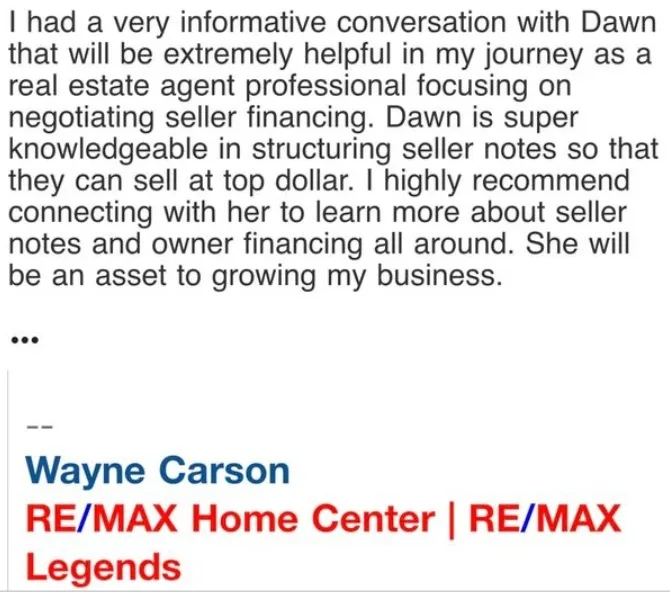
“I had a very informative conversation with Dawn that will be extremely helpful in my journey as a real estate agent focusing on seller financing. Dawn is super knowledgeable in structuring seller notes so they can sell at top dollar. I highly recommend connecting with her.”
Find Out What Your North Carolina Note Is Worth
Share a few details and we'll get back to you with a no-obligation review. Easy, free, confidential, and no commitment required.
Prefer to talk? Call us at 954-466-7111
No pressure or obligation offer · We Buy Notes Nationwide · Sell all or part of your note · Response usually within 1–3 business days