
Sell Part of Your Mortgage Note —
Keep the Rest
A partial note purchase lets you convert a defined number of future payments into a lump sum of cash today — without selling your entire note. You get the liquidity you need now, and the remaining payment stream comes back to you later.
Most note holders don't know this option exists. Many competitors won't offer it.
Request a FREE Note Review ✉ Get FREE Note TipsLiked this video? Watch more in our full video series →
How a Partial Purchase Works
Think of your note as a stream of future payments. In a partial purchase, you sell the right to receive the next portion of that stream — and keep everything after it. If you’ve wondered, “Can I sell my mortgage note without selling all of it?”, a partial purchase may be the answer. We buy mortgage notes in full or in part.
at closing — today
after the partial period ends
Step by Step
Share your note details — remaining balance, rate, payment history, property info. Our team evaluates whether a partial purchase is the right fit and how many payments we can offer to purchase.
We present a clear offer: how many payments we are purchasing, the lump sum you receive, and what the future income stream looks like when it returns to you. No pressure — take the time you need.
We order a title search and review the note documents. Most partial purchases close in 3–5 weeks. The borrower is notified of the payment transfer — their loan terms don't change.
Funds are wired at closing. The purchased payments flow to us for the agreed period. When that period ends, all future payments revert back to you automatically.
Full Sale vs. Partial Purchase — Which Is Right for You?
There is no universally right answer. It depends on your financial goals, how much cash you need, and how much you value the future income stream from your note.
Full Note Sale
Best for: Note holders who want to eliminate all future involvement, need maximum liquidity, or plan to reinvest the full proceeds.
Partial Note Purchase
PopularBest for: Note holders who want liquidity for a specific need — home improvement, debt payoff, investment — but still value the long-term income from their note.
Who Uses Partial Purchases?
The Retiring Seller
Sold a property owner-financed and is receiving monthly payments. Needs a lump sum now for retirement expenses but wants the income to resume in 5–7 years.
The Reinvestor
Has a solid investment opportunity today — another property, a business, stock — but doesn't want to permanently lose a reliable monthly income stream.
The Debt Eliminator
Carrying high-interest debt — credit cards, medical bills, a balloon payment due — and wants to wipe it out now without surrendering the full note.
The Divorcing Seller
Needs to divide assets and requires a cash settlement now, but the note represents a long-term asset neither party wants to walk away from entirely.
The Relocating Snowbird
Moving or downsizing and needs a lump sum for a new home purchase or relocation costs, but still wants the back end of the note as a retirement income source.
The Inherited Note Holder
Inherited a note from a parent or relative. Needs liquidity now to handle estate costs but wants to preserve the future income the note was meant to provide.
Free — No Obligation
Ready to Find Out What Your Note Is Worth?
Our team reviews your note details and responds within one business day — no fees, no pressure, no obligation.
Frequently Asked Questions
How does a partial note purchase work?
In a partial purchase, a note buyer purchases the right to receive a specific number of your future payments — for example, the next 60 monthly payments — in exchange for a lump sum of cash today. Once those payments have been received by the note buyer, the remaining payment stream reverts back to you. You get cash now and keep the back end of your note.
Will I get as much cash in a partial purchase as a full sale?
No — a partial purchase will typically yield less total cash than a full sale, because you are only selling a portion of the note's future income. However, a partial purchase lets you keep a significant future income stream while still getting the liquidity you need today. Many note holders find this trade-off is the right one for their situation.
What happens to my note after the partial purchase period ends?
Once the purchased payments have been collected by the note buyer, your note reverts back to you automatically. The borrower's payments then begin flowing back to you for the remainder of the note term. The transfer is handled through a servicing arrangement established at closing.
Does the borrower know about the partial purchase?
Yes. The borrower will be notified of the transfer and will receive instructions to send payments to the note buyer for the duration of the partial purchase period. This is a standard part of any note sale — full or partial. The borrower's loan terms do not change.
What documents do I need for a partial purchase?
The same documents you would need for a full sale: the original promissory note, your mortgage or deed of trust (depending on your state), a payment history, and the original closing statement. See our complete documents checklist for a full breakdown.
How long does a partial purchase take to close?
Most partial purchases close within 3 to 5 weeks from the time of your initial note review. The timeline depends on how quickly documents are gathered and whether a property valuation is needed. Well-documented, seasoned notes typically close on the faster end.
Why Note Holders Choose Moxxie Asset Group
Selling a mortgage note is a one-time decision for most note holders. You deserve a buyer who is straightforward, experienced, and focused on your outcome — not just a quick close at the lowest possible price. A partial purchase lets you sell mortgage note payments for a set period and keep the rest — one more reason we buy mortgage notes on terms that fit your goals.
We Know Seller Financed Notes
Our team understands how mortgage and deed of trust notes are structured across every state — and what makes a note trade at full value. Whether you plan to sell a note now or later, we review notes nationwide and give you an honest, informed assessment — not a lowball offer.
Honest, No-Pressure Process
Whether you are selling a mortgage note in full or selling mortgage note payments in part, our team reviews your note and responds within one business day. We walk you through exactly how we arrived at our offer — no mystery pricing, no bait-and-switch, no pressure. If a full sale isn't right for you, we'll tell you. A partial note purchase may be a better fit.
Free Review — No Fees, Ever
There are no upfront fees, no application costs, and no obligation. We cover our costs at closing — only if you decide to sell. Call 954-466-7111 or request your free review below.
Request a FREE Note Review ✉ Get FREE Note TipsReal Feedback From Real People
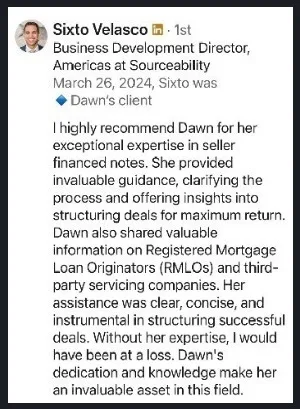
“I highly recommend Dawn for her exceptional expertise in seller financed notes. She provided invaluable guidance, clarifying the process and offering insights into structuring deals for maximum return. Her assistance was clear, concise, and instrumental in structuring successful deals.”

“I was pleasantly surprised that you were willing to give me advice as a newer investor from an objective position trying to help me move forward. Free advice, no expectations, and a kind demeanor. You were knowledgeable, patient, and definitely have an abundance mindset!”
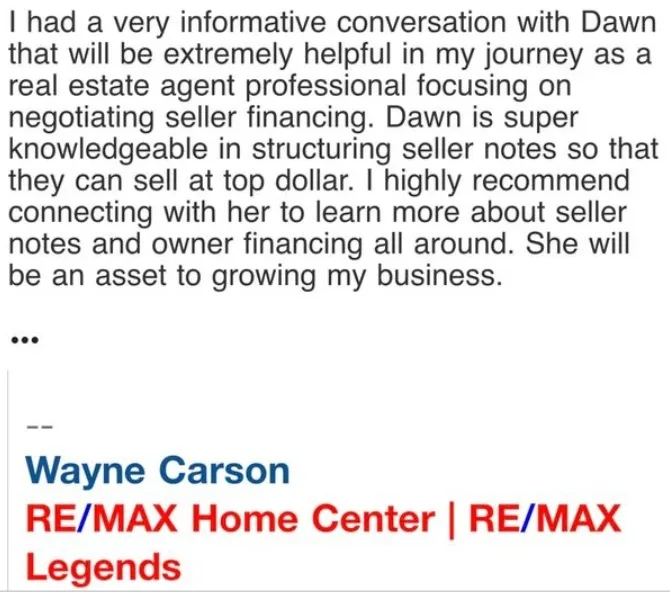
“I had a very informative conversation with Dawn that will be extremely helpful in my journey as a real estate agent focusing on seller financing. Dawn is super knowledgeable in structuring seller notes so they can sell at top dollar. I highly recommend connecting with her.”
Not Sure If a Partial Purchase Is Right for You?
Our team will walk you through both options — full and partial — and give you a clear picture of what each looks like for your specific note. No pressure, no obligation. Just an honest evaluation. Selling a note is often simpler than note holders expect.