
What Documents Do I Need
to Sell My Mortgage Note?
A complete checklist — with state-specific guidance on mortgage vs. deed of trust states. You don't need every document before reaching out, but knowing what to gather speeds up your review and closing.
Request a FREE Note Review ✉ Get FREE Note TipsLiked this video? Watch more in our full video series →
The Core Document Checklist
These are the documents every mortgage note buyer will need — regardless of which state your property is in. Having these ready before your free note review will speed up your evaluation and your closing. Many note holders who search “sell my mortgage note” aren’t sure where to begin. We buy mortgage notes across all 50 states, and this is one of the topics we help sellers work through before they sell mortgage note payments.
The Original Promissory Note
This is the primary document — the signed legal promise from the borrower to repay the loan. It contains the loan amount, interest rate, payment schedule, and maturity date. Note buyers cannot purchase your note without reviewing the original. If you don't have the original, contact the title company or closing attorney from when the sale was made — they often retain copies.
Your Mortgage or Deed of Trust (depending on your state)
This is the security instrument — the recorded document that ties the promissory note to the real property. You should gather your mortgage or deed of trust depending on which state the property is in. Both serve the same purpose: they give the note holder the right to foreclose if the borrower stops paying. This document should be recorded with your county — if you don't have a copy, it is available through your county recorder's office or through a title search.
Payment History
A record of every payment received — dates, amounts, and any missed or late payments. This can be a simple spreadsheet, bank statements, or a payment log you've kept. Seasoned notes with a consistent payment history sell for more than newer notes. The longer and cleaner the payment record, the stronger your offer will be.
Closing or Settlement Statement
The HUD-1 or closing disclosure from the original sale. This shows the original purchase price, down payment, loan amount, and the terms agreed upon at closing. It helps a note buyer quickly verify that the note was created at arm's length and that the original terms are consistent with what is in the promissory note.
Property Information
The full property address, property type (single-family, multi-family, commercial, land), and ideally a recent estimate of current market value. Note buyers will order their own valuation, but having a recent appraisal, tax assessment, or Zillow estimate helps speed things up. The property value relative to the remaining loan balance (loan-to-value ratio) is one of the biggest factors in your note's price.
Title Insurance Policy (if available)
If a title insurance policy was issued when the note was created, include it. Title insurance protects against claims on the property and gives a note buyer confidence in the chain of title. Not all seller-financed transactions involve title insurance — if there was none, that is not a deal-breaker, but the buyer may require a new title search during due diligence.
Any Loan Modifications or Amendments
If the note has ever been modified — a change in interest rate, payment amount, deferral, or maturity date extension — include any signed modification agreements. Undisclosed modifications can delay or derail a closing, so it is important to be upfront about the full history of the note.
Mortgage State vs. Deed of Trust State — What You Need to Know
The single most common point of confusion for note holders is the difference between a mortgage and a deed of trust. Both secure the promissory note to the property — but they are different legal instruments, and which one you have depends entirely on the state where the property is located.
Mortgage States
Your security instrument is called a mortgage. Foreclosure in these states is judicial — meaning it goes through the court system, which takes longer (often 12–24+ months in some states).
Note: Longer foreclosure timelines can reduce note pricing slightly — buyers price in the risk of a longer workout if the borrower defaults.
Deed of Trust States
Your security instrument is called a deed of trust. Foreclosure is typically non-judicial — handled outside of court through a trustee, making it faster (often 60–180 days).
Note: Faster foreclosure timelines generally mean better pricing for note sellers, as buyers face less risk in the event of borrower default.
Not sure which instrument you have? Simply look at the document title on the recorded instrument from your closing — it will say "Mortgage" or "Deed of Trust" (or occasionally "Trust Deed"). If you can't locate it, we can help you find it during your free note review. When in doubt: gather your mortgage or deed of trust depending on your state, and we'll sort out the details together.
Free — No Obligation
Ready to Find Out What Your Note Is Worth?
Our team reviews your note details and responds within one business day — no fees, no pressure, no obligation.
You Don't Need Everything to Get Started
Many note holders assume they need a perfectly organized file before they can reach out to a note buyer. That is not the case. Our team can begin a preliminary evaluation with just a few key pieces of information:
Start with what you have. Our team will tell you exactly what else is needed once we understand your note — and we will guide you through locating anything that is missing. There is no pressure and no obligation. A free note review is always the best first step.
Inherited your note? Inherited notes often come with incomplete paperwork, and that’s okay. See what to know if you’ve inherited a mortgage note before you decide anything.
What Note Buyers Are Actually Evaluating
When our team reviews your documents, here is what we are looking at — and how each factor affects your offer:
The creditworthiness of the borrower making payments on your note. A stronger credit score signals lower default risk and directly improves your offer. Even a rough credit range — strong, fair, or weak — helps us evaluate the note before a full review.
The larger the original down payment, the more skin in the game the borrower had from day one. A 10%+ down payment is a strong signal of borrower commitment and significantly reduces default risk — making your note more attractive to note buyers.
The remaining loan balance divided by the current property value. Lower LTV means more equity in the property — the single biggest pricing factor.
How many consecutive on-time payments the borrower has made. 12+ months of clean payment history significantly improves your offer.
First position notes are far easier to sell than second position notes. A second lien means another lender has priority claim on the property — that adds risk and typically reduces the offer significantly.
Higher interest rates on your note generally mean a better yield — and therefore a better offer — for the note buyer.
Single-family residential notes in desirable markets command better pricing than rural land or commercial notes. Strong markets like Miami, Atlanta, Houston, and Phoenix are favorable.
Deed of trust states with faster non-judicial foreclosure timelines are generally more favorable for note buyers — and that can translate into a slightly better offer for you.
How long ago the note was created. Very new notes with under 6 months of payment history are harder to price — but once seasoning builds, age alone is rarely a deciding factor.
Whether the property is owner-occupied, tenant-occupied, or vacant. Owner-occupied is the preferred scenario, but tenant-occupied notes are still purchasable. Vacant properties carry the most risk.
The price the property sold for when the note was created. Helps verify the transaction was arm's length and the original LTV was reasonable — useful context but rarely changes the offer on its own.
Very small note balances — typically under $30,000–$40,000 — can be harder to sell because transaction costs consume more of the yield. Not a dealbreaker, but it may affect pricing on smaller notes.
Whether the note is fully amortizing, interest-only, or has a balloon payment. Standard amortizing notes are the easiest to price. Balloon and interest-only structures are purchasable but require additional analysis.
Ready to get started? Request a FREE Note Review and our team will walk you through exactly what we need.
Frequently Asked Questions
Do I need the original promissory note to sell my mortgage note?
Yes, the original promissory note is the primary document a note buyer needs to evaluate and purchase your note. If the original is lost, it may be possible to obtain a lost note affidavit, but this adds complexity and time to the process. Our team can advise you on next steps if the original cannot be located.
What is the difference between a mortgage and a deed of trust for note selling purposes?
Both are security instruments that tie the promissory note to the property — but they differ in the foreclosure process involved. Mortgage states (like Florida, Ohio, and Michigan) require judicial foreclosure through the courts, which takes longer. Deed of trust states (like Texas, California, and North Carolina) allow faster non-judicial foreclosure. Note buyers factor the foreclosure timeline into their pricing. Either way, gather your mortgage or deed of trust depending on your state.
Can I start the note review process before I have all my documents?
Yes. Our team can often begin an initial evaluation with just the basic details — property address, original loan amount, interest rate, remaining balance, and payment history. You do not need to have every document in hand before reaching out. We will walk you through exactly what we need as we get further into the process.
What happens if my borrower has missed payments?
Non-performing notes are harder to sell and typically sell at a steeper discount than performing notes. That said, there is still a market for them. Our team will review your situation and let you know what options are available — including whether waiting for the borrower to resume payments would meaningfully improve your offer.
Why Note Holders Choose Moxxie Asset Group
Selling a mortgage note is a one-time decision for most note holders. You deserve a buyer who is straightforward, experienced, and focused on your outcome — not just a quick close at the lowest possible price. Ready to sell mortgage note payments, or just want to know what a buyer would pay? We buy mortgage notes nationwide — Request a FREE Note Review anytime.
We Know Seller Financed Notes
Our team understands how mortgage and deed of trust notes are structured across every state — and what makes a note trade at full value. Whether you plan to sell a note now or later, we review notes nationwide and give you an honest, informed assessment — not a lowball offer.
Honest, No-Pressure Process
Whether you are selling a mortgage note in full or selling mortgage note payments in part, our team reviews your note and responds within one business day. We walk you through exactly how we arrived at our offer — no mystery pricing, no bait-and-switch, no pressure. If a full sale isn't right for you, we'll tell you. A partial note purchase may be a better fit.
Free Review — No Fees, Ever
There are no upfront fees, no application costs, and no obligation. We cover our costs at closing — only if you decide to sell. Call 954-466-7111 or request your free review below.
Request a FREE Note Review ✉ Get FREE Note TipsReal Feedback From Real People
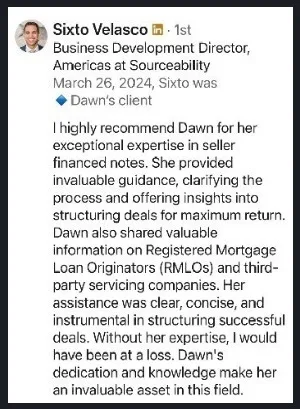
“I highly recommend Dawn for her exceptional expertise in seller financed notes. She provided invaluable guidance, clarifying the process and offering insights into structuring deals for maximum return. Her assistance was clear, concise, and instrumental in structuring successful deals.”

“I was pleasantly surprised that you were willing to give me advice as a newer investor from an objective position trying to help me move forward. Free advice, no expectations, and a kind demeanor. You were knowledgeable, patient, and definitely have an abundance mindset!”

“I had a very informative conversation with Dawn that will be extremely helpful in my journey as a real estate agent focusing on seller financing. Dawn is super knowledgeable in structuring seller notes so they can sell at top dollar. I highly recommend connecting with her.”
Ready to Find Out What Your Note Is Worth?
Start with what you have. Our team will guide you through the rest — no pressure, no obligation. A free note review is always your best first step toward understanding your options. Selling a note is often simpler than note holders expect.