
Liked this video? Watch more in our full video series →
Dawn — Senior Seller Finance Note Advisor & Analyst
Moxxie Asset Group · Ft. Lauderdale, FL
Quick Answers
- → You don't need everything to get started — basic note details get the free review process going right away
- → Key document: promissory note + mortgage or deed of trust (depending on your state) — these two establish the legal basis for the sale
- → Payment history is the single most important document for pricing — it directly affects the offer you receive
- → Missing paperwork delays the process but rarely kills a deal — our team helps you fill gaps during due diligence
- → Typical closing time: 3–5 weeks when all documents are received and title is clear — free review, no obligation
One of the most common questions we hear from note holders is: "What do I actually need to sell my note?" It's a reasonable question — most people have never done this before, and the process can feel opaque. The good news is that having documents ready speeds up your review and your offer significantly, but you do not need everything in hand to get started. A free note review can begin with just the basics, and we help you identify what else is needed along the way. If you’ve ever asked yourself, “Should I sell my mortgage note?”, this information will help you think it through. We buy mortgage notes nationwide, and understanding these details can help you sell mortgage note payments on the best possible terms.
This guide walks through each document in plain English — what it is, why note buyers need it, and what to do if you can't find it. Keep our quick-reference documents checklist bookmarked as a companion to this article.
The 7 Core Documents to Sell a Mortgage Note
When you go to sell mortgage note payments on the secondary market, note buyers are looking for a clear picture of what they're buying. These seven documents give them that picture.
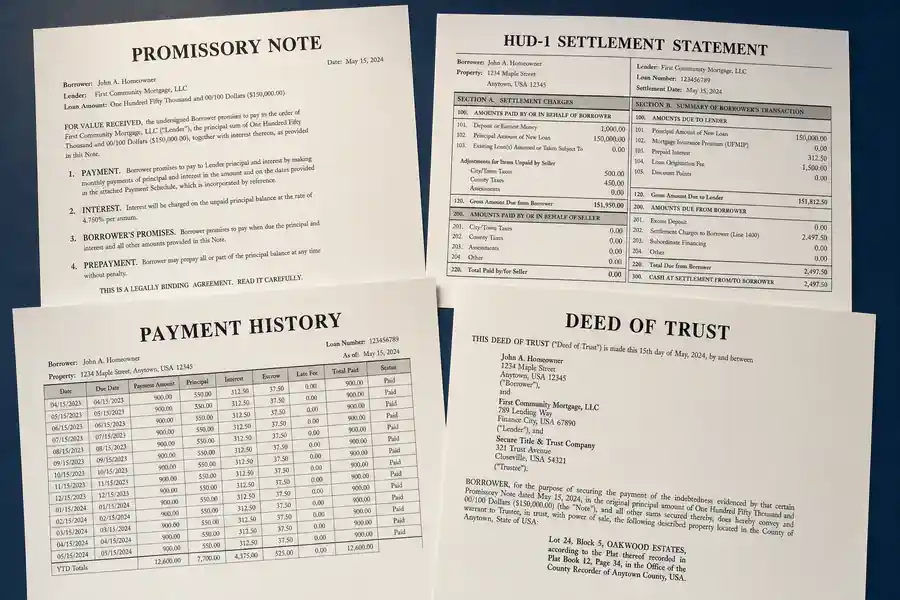
1. The Promissory Note
The promissory note is the foundation of your seller financed transaction — it's the document signed by the borrower that spells out the loan amount, interest rate, payment schedule, and repayment terms. Without a copy of the original promissory note, a mortgage note buyer cannot verify what was actually agreed to. If you have lost the original, contact the title company or settlement agent from the original closing. Many retain copies in their files. Your note buyer can also help you locate or reconstruct this document during due diligence.
2. The Mortgage or Deed of Trust
Always gather your mortgage or deed of trust (depending on your state) — this is the security instrument that ties the promissory note to the real property. It's what gives the lender (and, after a sale, the note buyer) the right to foreclose if the borrower stops paying. Some states use mortgage instruments while others use deeds of trust — the difference matters for how foreclosure is handled and how note buyers price your note. Since this document is recorded with the county, a copy can be obtained from the county recorder's office if you can't find yours.
3. Payment History
Payment history is the single most important document for pricing your note. A 12–24 month record of on-time payments from your borrower is what "seasons" a note and gives note buyers confidence in the borrower's reliability. If you've been collecting payments personally, bank statements showing deposits work well. If you used a loan servicing company, ask them for an account statement or payment ledger. The more consistent and documented the payment history, the stronger your offer will be when you sell mortgage note payments.
4. The Original Closing Statement (HUD-1 or Settlement Statement)
The closing or settlement statement from when the owner financed transaction was created shows the purchase price, down payment, loan amount, and other terms of the original deal. Note buyers use this to verify the note's history and calculate the original loan-to-value ratio. If you don't have this document, the title company or closing attorney from the original transaction should have a copy on file.
Free — No Obligation
Ready to Find Out What Your Note Is Worth?
Thinking about selling a note? Our team reviews your note and responds within one business day — no fees, no pressure, no obligation.
5. Property Information
Note buyers need basic property information to assess the collateral securing your note. This includes the full property address, property type (single-family, multi-family, commercial, land), and ideally an estimated current market value. You don't need a formal appraisal at this stage — a reasonable estimate based on comparable sales in the area is usually sufficient for the initial review. The buyer will order their own valuation during due diligence if needed.
6. Title Insurance Policy (If Available)
If a title insurance policy was issued when the original owner financed transaction closed, having a copy helps the note buyer understand the chain of title and any known encumbrances on the property. Not every seller financed deal has a title policy, and not having one is not disqualifying — but it will mean the buyer orders a title search during due diligence, which adds a small amount of time to closing.
7. Loan Modifications or Side Agreements
If you have ever modified the terms of the original note — extended the maturity date, changed the payment amount, restructured the interest rate, or agreed to a forbearance — those modifications need to be disclosed and documented. An undisclosed modification discovered during due diligence can delay or derail a sale. If you have any written or even informal agreements with the borrower that affect how the note is being repaid, bring them up early in your review.
Mortgage vs. Deed of Trust: Why the Difference Matters
When note buyers evaluate the documents needed to sell mortgage note payments, one of the first things they check is whether your state uses a mortgage instrument or a deed of trust. This distinction affects the foreclosure process — and foreclosure timelines directly affect how note buyers price seller financed paper.
Mortgage states (including Florida, Ohio, and Michigan) require judicial foreclosure — a court process that typically takes 6–18 months or longer depending on the state. This longer timeline means more risk for note buyers if a borrower defaults, which generally translates into a larger discount on notes from these states.
Deed of trust states (including Texas, North Carolina, Washington, California, Georgia, Tennessee, Arizona, Colorado, and Oregon) allow non-judicial foreclosure through a trustee sale process. Timelines are typically much faster — ranging from 41 days in Texas to around 150 days in Oregon — which reduces buyer risk and can support stronger pricing on your note.
When you gather your mortgage or deed of trust (depending on your state), look at the top of the document — it will identify itself clearly as a "Mortgage," "Deed of Trust," or "Land Contract" depending on your state's conventions. The state foreclosure law attached to that instrument is one of the key factors note buyers weigh when they evaluate documents needed to sell mortgage note payments.
For a full breakdown of state instrument types and foreclosure timelines, our documents reference page provides a quick state-by-state guide. You can also explore our partial note purchase page if you are interested in selling only a portion of your remaining payment stream.
What You DON'T Need to Get Started
A lot of note holders delay reaching out to a mortgage note buyer because they think they need to have everything perfectly organized first. You don't. Here's what a free note review can typically start with:
- Property address — so the buyer can pull basic property data
- Remaining balance — approximate is fine at this stage
- Interest rate and monthly payment — the core terms of the note
- General payment history — has the borrower been paying on time? For how long?
That's enough to have a meaningful conversation with a note buyer about what your note might be worth and whether it's a strong candidate for sale. The full list of documents needed when selling a mortgage note comes into play later — during the formal review and due diligence process — not before you even start.
What Note Buyers Are Actually Looking For
Understanding why note buyers ask for each document helps you prioritize what to gather first. Here are the key factors a mortgage note buyer evaluates when pricing a seller financed note:
- Loan-to-value ratio (LTV). How much is the remaining loan balance relative to the property's current market value? Lower LTV means more borrower equity — and more protection for the buyer if something goes wrong. This is why property information matters.
- Payment seasoning. The longer the borrower has been paying on time, the more confidence a note buyer has in their reliability. Payment history documents this track record directly. Notes with 12–24 months of clean payment history typically command stronger offers.
- Interest rate. Owner financed notes often carry interest rates above current lending market rates. Notes with above-market rates generate more return for a buyer, which can translate into stronger pricing for you.
- Property type and location. Single-family residential notes in strong markets are the most liquid — they are easiest for note buyers to evaluate and resell. Commercial, land, or rural notes may carry a larger discount due to thinner buyer demand.
- State foreclosure law. As discussed above, the state's foreclosure timeline — tied directly to the mortgage or deed of trust instrument — affects how note buyers price risk. When you are selling a mortgage note, a note in a fast-foreclosure state will often yield a stronger offer than the same note in a slow judicial state.
- Note terms and remaining balance. A larger remaining balance and longer remaining term generally produce a better offer, since the buyer acquires more payment stream. Very small balances (under $25,000) may attract fewer buyers in the market.
Frequently Asked Questions
Do I need the original promissory note to sell my mortgage note?
In most cases, yes — note buyers want to see the original promissory note or a certified copy. The promissory note is the core document that establishes the borrower's legal obligation to repay. Without it, buyers have no way to verify the terms, interest rate, payment schedule, or remaining balance. If you cannot locate the original, contact the title company or settlement agent who handled the original closing — they often keep copies in their file. A reputable note buyer can also help guide you through this process if the original promissory note has been lost.
What if I can't find my mortgage or deed of trust?
Your mortgage or deed of trust (depending on your state) is a recorded public document, which means a copy can typically be obtained from the county recorder's or clerk's office where the property is located. Many counties now offer online document retrieval at little or no cost. If you are unsure whether your state uses a mortgage or deed of trust instrument, your note buyer can tell you based on the property's location. Our team can often pull a recorded copy on your behalf during due diligence if you cannot locate yours.
Can I start before I have all the documents?
Yes. You do not need to have every document in hand to get started. A free note review can begin with just the basics: the property address, the remaining balance, the interest rate, and a general sense of the borrower's payment history. Note buyers who specialize in seller financed paper understand that these documents are sometimes scattered — originals stored in old files, closing statements at the title company, payment history across bank accounts. Having documents ready speeds up your review and your offer, but a missing document delays the process rather than ending it. Request your free note review and we'll walk you through what's needed at each step.
Whether you have every document organized and ready or you're starting from scratch with just the basics, the right first step is the same: connect with an experienced mortgage note buyer who can review your specific situation and give you an honest picture of what your note is worth. Visit our full documents checklist page for a printable quick-reference list, or request your free note review today and we'll take it from there.