
Dawn — Senior Seller Finance Note Advisor & Analyst
Moxxie Asset Group · Ft. Lauderdale, FL
Key Takeaways
- →Timeline is the real issue — every month a foreclosure drags on is a month your note earns nothing
- →Foreclosure is a last resort — a loan modification is almost always the first move
- →Borrower risk outweighs state — credit, down payment, and payment history carry far more weight
- →State law multiplies risk — it matters most when the borrower is higher risk
If you’re holding a seller-financed note, the state your property sits in matters more than most people realize, not because of where the property is, but because of what happens if your borrower ever stops paying. Here’s the honest breakdown of why.
Why Foreclosure Timeline Actually Matters
The longer it takes to foreclose, the longer your investment sits earning nothing. That’s the real issue. Every month a foreclosure drags on is a month your note isn’t generating yield, and in states with lengthy judicial processes, that can stretch into years.
It gets worse from there. A borrower who’s being foreclosed on typically isn’t maintaining the property anymore. Since that property is your collateral, the longer the process drags on, the more its condition, and its value, tends to decline.
And here’s something most people don’t understand about foreclosure at all: when you finally do foreclose, you’re only entitled to recover your unpaid balance and the fees you incurred during the process, not any of the equity in the property. If there’s real equity, the property typically gets scooped up by investors at auction before you ever end up owning it. The properties note holders actually end up taking back tend to be the ones with little to no equity, often in poor condition, the exact properties nobody else wanted to bid on.
When that happens, you may have to sell at a loss just to recoup part of your investment, or put more money into repairs before you can sell at all. Either way, your yield takes a real hit.
Foreclosure Is a Last Resort, Not the Goal
A common misconception is that note buyers want to foreclose, that we’re hoping to scoop up the property and its equity. In reality, foreclosure is almost never in a note buyer’s best interest. It’s slow, it’s expensive, and as explained above, it rarely results in capturing meaningful equity.
Before foreclosure ever becomes necessary, the first move is almost always a loan modification, working with the borrower to get the note back into performing status. The best candidate for a modification is simply a borrower who’s willing to work with you. A borrower who disappears and stops communicating entirely is the real warning sign. Most borrowers who fall behind are dealing with a one-time, temporary hardship, not a permanent inability to pay, and a modification, often deferring the missed payments to the back of the loan, can get them through it without ever heading toward foreclosure.
How Much State Actually Affects Pricing
Here’s the honest answer: state matters, but it’s rarely the deciding factor on its own. Borrower risk, credit, down payment, and length of verified on-time payment history, carries far more weight in how a note gets priced.
The relationship between the two is simple: the higher the borrower’s risk, the more the state’s foreclosure process matters, because a higher-risk borrower means a real chance you’ll actually need to use that process. For a genuinely low-risk borrower, state becomes almost irrelevant, since foreclosure is unlikely to ever come into play at all.
Fast, Non-Judicial States: Real Advantages
States with short, non-judicial foreclosure processes are simply more attractive to note buyers. There’s less time waiting to recover an investment, and less time for a struggling borrower’s neglect to damage the property if it does come back.
Some of the fastest states in the country, though timelines shift with changes in state law and court backlogs, so treat these as general ranges rather than fixed numbers:
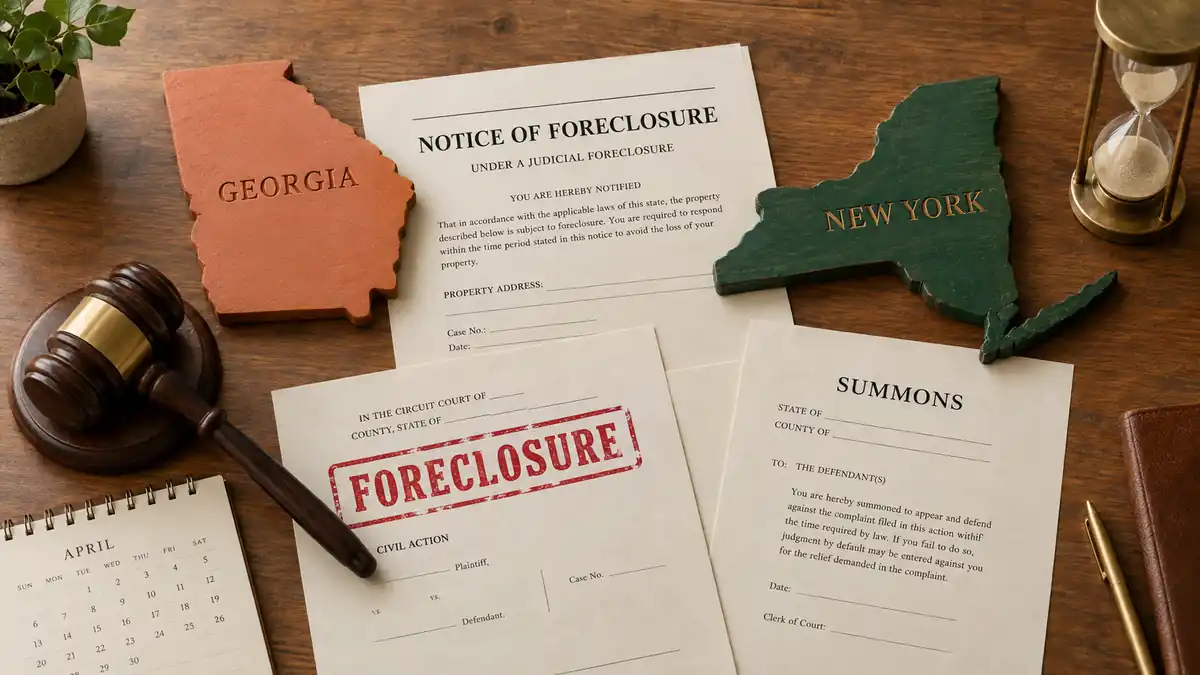
- Georgia — arguably the fastest in the nation, though it’s often left out of national rankings due to how the state records foreclosure data. No court approval required; once the required 120-day federal delinquency window passes, Georgia only requires a 30-day notice plus four consecutive weeks of newspaper advertisement. A foreclosure can be completed in as little as 37 to 60 days.
- New Hampshire — roughly 110 to 184 days
- Texas — roughly 116 to 258 days
- Montana — roughly 133 days
- Wyoming — roughly 136 to 172 days
- Nebraska — roughly 112 days
Slow, Judicial States: The Real Cost
On the other end, some states make the process genuinely difficult for note holders. Again, these figures move with court backlogs and legal changes, so they’re general ranges, not guarantees:
- New York — among the longest in the country, with timelines that can stretch past 1,700 days, and even longer in New York City specifically, due to judicial backlogs and mandatory settlement conferences
- Hawaii — around 900 days, driven by strict judicial requirements and court scheduling delays
- New Jersey — around 810 days, with mandatory mediation requirements
- Connecticut and Maryland — around 780 days, both heavily reliant on court approval at every step
New York specifically is a state Moxxie tends to avoid taking on directly. That said, it’s not entirely off the table, notes from difficult states like New York can sometimes still be placed with other buyer partners who specialize in those markets, so it’s always worth asking rather than assuming a note is unsellable because of its state.
The Bottom Line
State-specific foreclosure law is a real factor in how your note gets priced, but it’s a multiplier on risk, not the risk itself. A strong, low-risk note will price well almost regardless of state. A borderline or higher-risk note is where state law starts to matter a great deal, since it directly shapes what happens if things go wrong.
If you’re not sure how your note’s state and borrower profile combine to affect its value, that’s exactly what a free, no-obligation review is for.
📞 954-466-7111
🌐 www.MoxxieAssetGroup.com
Disclaimer: This post is for informational purposes only and does not constitute legal advice. Foreclosure timelines are general ranges that change with state law and court backlogs, so consult a qualified real estate attorney about your specific situation.
Frequently Asked Questions
Does my state’s foreclosure law affect what my note is worth?
Yes, but it’s rarely the deciding factor on its own. Borrower risk, including credit, down payment, and length of verified on-time payment history, carries far more weight. State law acts as a multiplier on that risk: the higher the borrower’s risk, the more the state’s foreclosure process matters to a note buyer.
Which states have the fastest foreclosure process?
Non-judicial states move fastest. Georgia is arguably the fastest in the nation, often completing a foreclosure in as little as 37 to 60 days after the federal 120-day delinquency window. New Hampshire, Texas, Montana, Wyoming, and Nebraska are also relatively fast, though timelines shift with changes in state law and court backlogs.
Can I still sell a mortgage note on a property in New York?
Often, yes. New York has one of the longest foreclosure timelines in the country, and Moxxie tends to avoid taking those notes on directly, but notes from difficult states can sometimes be placed with other buyer partners who specialize in those markets. It’s always worth asking before assuming a note is unsellable.
Moxxie Asset Group:
THE Source for Seller Financed Note Education
Illuminating the Blind Spots of Your Seller Financed Note Journey