

Dawn — Senior Seller Finance Note Advisor & Analyst
Moxxie Asset Group · Ft. Lauderdale, FL
It happens in nearly every note review conversation our team has. The note holder is ready. They want to sell. And then they pause and say something like: "But will my borrower let me do this?" or "My buyer is not going to cooperate — they won't give their Social Security number." Many note holders who search “sell my mortgage note” aren’t sure where to begin. We buy mortgage notes across all 50 states, and this is one of the topics we help sellers work through before they sell mortgage note payments.
This worry stops people from moving forward who otherwise had a perfectly sellable note. So let's clear it up completely.
Your Note. Your Right to Sell.
A promissory note is a negotiable instrument. When you hold a mortgage note — whether you seller financed a property or inherited the note — you hold an asset. And like most assets, you have the right to sell it, assign it, or transfer it without asking anyone's permission.
Your borrower agreed to repay a debt. That obligation — the promise to pay — transfers with the note. The borrower doesn't own the note. They owe on it. Those are very different things.
The borrower has no legal right to block, veto, or withhold consent from a note sale. They cannot refuse. They cannot prevent it. They cannot demand to stay put with the original note holder. The transaction is between you and the mortgage note buyer — the borrower is not a party to that transaction.
Free — No Obligation
Ready to Find Out What Your Note Is Worth?
Thinking about selling a note? Our team reviews your note and responds within one business day — no fees, no pressure, no obligation.
What About the Credit Check?
Here is where the confusion really runs deep. When a mortgage note buyer purchases a note, they underwrite it — which includes pulling the borrower's credit report to assess default risk. And note holders immediately worry: "My borrower isn't going to allow that. They'll say no."
The borrower's permission is not required.
Under the Fair Credit Reporting Act (FCRA), any party that is purchasing or evaluating a credit obligation secured by real property has what is called a "permissible purpose" to access the borrower's credit report — without needing the borrower's consent. This is federal law. The note buyer's right to pull that credit report exists independently of whatever the borrower thinks about it.
The borrower cannot block it. They cannot demand to opt out. They have no legal mechanism to prevent it.
What If I Never Pulled Credit — and Don't Have the SSN?
This is extraordinarily common in owner financed transactions. Many seller financed deals are done on trust — the seller knew the buyer, the buyer had a good reputation in the community, and no one ran a formal credit application. No SSN was collected. No credit report was pulled. The deal was done on a handshake and a signed promissory note.
That does not disqualify your note from being sold.
You are not required to provide your borrower's Social Security number to a note buyer. The note buyer's underwriting team locates and accesses credit information through standard industry processes — using the borrower's name, property address, and other identifiers available through public records and credit bureau systems. Your job as the note seller is to provide the note documents and payment history. You are not expected to track down personal borrower information you never collected in the first place.
The short version:
- Your borrower cannot stop the note sale
- The note buyer does not need the borrower's consent to pull credit
- You do not need to provide your borrower's SSN
- If you never collected it — that is fine and expected
- The note buyer's team handles the due diligence process
What IS Required: Notifying the Borrower After the Sale
There is one legal requirement that does involve the borrower — but it comes after the note has already been sold and funded, not before. Federal law under RESPA (the Real Estate Settlement Procedures Act) requires that the borrower be notified in writing when a mortgage note is sold or transferred to a new holder.
This notice tells the borrower:
- Who now holds the note
- Where to send future payments
- That their loan terms — interest rate, payment amount, schedule — do not change
The note buyer handles this notification as part of the closing process. You do not need to manage it. And crucially — this is a notification, not a consent request. The borrower is being informed, not asked.
Does a No-Credit-Check Note Hurt My Offer?
It can — but it is not fatal. When a note was originated without a formal credit check, the note buyer doesn't have a credit score to anchor their risk assessment. In that situation, the payment history carries even more weight. A borrower who has made 36 straight on-time payments is, functionally, demonstrating creditworthiness — even without a score from origination.
Other factors that matter more when credit data at origination is thin:
- Down payment at origination — a borrower who put 20–30% down has significant equity at stake
- Payment seasoning — how long and how consistently payments have been made
- Current LTV — if property values have risen, the equity cushion protects the buyer
- Property type and location — single-family homes in stable markets are lower risk
The bottom line: the absence of a credit check at origination is a data gap, not a disqualifier. A reputable mortgage note buyer will tell you honestly how it affects your offer. Before you request an offer, gather your mortgage or deed of trust (depending on your state), along with your payment history and original closing documents.
Frequently Asked Questions
Does my borrower have to consent to a note sale?
No. As the note holder, you have the legal right to sell or transfer your mortgage note without your borrower's permission. A promissory note is a negotiable instrument — the right to receive payments is yours to sell. The borrower has no right of refusal and no legal mechanism to block the transfer.
Does the note buyer need my borrower's Social Security number to pull credit?
Not necessarily from you. Under the FCRA, the note buyer has a permissible purpose to access the borrower's credit report as part of evaluating the purchase. Their underwriting team handles the credit pull using the borrower's name, property address, and other available identifiers. If you never collected the borrower's SSN at origination — very common in owner financed deals — that is not your problem to solve.
What if my borrower says they won't allow the sale?
They cannot legally stop it. They may express displeasure, but a borrower has no right of refusal when it comes to who holds their note. The only post-sale obligation is that they receive a written notice of transfer informing them where to send future payments — which the note buyer handles as part of closing. Their loan terms do not change.
Why Note Holders Choose Moxxie Asset Group
Selling a mortgage note is a one-time decision for most note holders. You deserve a buyer who is straightforward, experienced, and focused on your outcome — not just a quick close at the lowest possible price. If you’re still wondering, “Should I sell my mortgage note?”, our team is happy to talk it through. We buy mortgage notes in all 50 states.
We Know Seller Financed Notes
Our team understands how mortgage and deed of trust notes are structured across every state — and what makes a note trade at full value. Whether you plan to sell a note now or later, we review notes nationwide and give you an honest, informed assessment — not a lowball offer.
Honest, No-Pressure Process
Whether you are selling a mortgage note in full or selling mortgage note payments in part, our team reviews your note and responds within one business day. We walk you through exactly how we arrived at our offer — no mystery pricing, no bait-and-switch, no pressure. If a full sale isn't right for you, we'll tell you. A partial note purchase may be a better fit.
Free Review — No Fees, Ever
There are no upfront fees, no application costs, and no obligation attached to your review. We cover our costs at closing — only if you decide to sell. Call 954-466-7111 or request your free review below.
Request a FREE Note Review ✉ Get FREE Note TipsFree — No Obligation
Not ready to sell yet? Get free insider note tips.
Note valuation tips, market trends & state-specific strategies — straight to your inbox.
✉ Get Free Note TipsReal Feedback From Real People
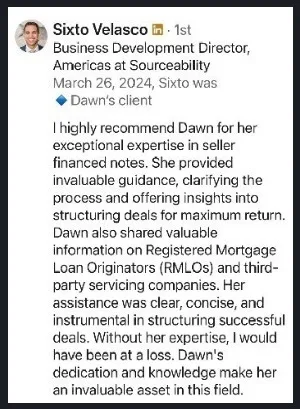
“I highly recommend Dawn for her exceptional expertise in seller financed notes. She provided invaluable guidance, clarifying the process and offering insights into structuring deals for maximum return. Her assistance was clear, concise, and instrumental in structuring successful deals.”

“I was pleasantly surprised that you were willing to give me advice as a newer investor from an objective position trying to help me move forward. Free advice, no expectations, and a kind demeanor. You were knowledgeable, patient, and definitely have an abundance mindset!”

“I had a very informative conversation with Dawn that will be extremely helpful in my journey as a real estate agent focusing on seller financing. Dawn is super knowledgeable in structuring seller notes so they can sell at top dollar. I highly recommend connecting with her.”
No Fees. No Obligation.
Ready to Find Out What Your Note Is Worth?
Our team reviews your note and responds within one business day. No fees, no pressure, no obligation.